Ibón García Gómez

MSc Physics · ML Researcher · IFCA-CSIC

I build physics-informed deep learning systems for hard inverse problems: from VMAT radiotherapy dose prediction at IFCA-CSIC, to sub-micron silicon detector reconstruction Challenging the current state of art when considering solo-pixel, to stellar-stream segmentation aligned with the ESA ARRAKIHS mission.

IFCA-CSIC · ARRAKIHS Science Collaboration (ESA F-class) · Univ. Cantabria
SOTA · 1.82 µm hit reconstruction γ 3 %/3 mm ≈ 61 % EBRT surrogate IoU > 0.84 stream segmentation First-author paper · in prep.

Currently completing the MSc in Particle Physics at the University of Cantabria, with two parallel research projects co-supervised by IFCA-CSIC: a Master's Thesis on U-Net segmentation of stellar streams for the ESA ARRAKIHS science case, and a Research Project on symmetry-aware deep learning for hexagonal 3D-trench silicon pixels, where the upcoming experimental cross-check is expected to lead to a first-author publication.

In parallel, I lead an end-to-end deep-learning pipeline for prostate VMAT radiotherapy: a Geant4 / OpenGATE Monte Carlo dataset coupled to a 3D TransUNet+FiLM neural surrogate, developed with anonymised clinical data kindly shared by a medical physicist at Hospital Universitario de León. The project is currently being submitted to the Santander X and UCEM innovation calls.

Ibón García Gómez

SANTANDER, SPAIN

ESA F-class · selected 2023 · launch ~2030 Member · Science Collaboration

ARRAKIHS. Analysis of Resolved Remnants of Accreted galaxies as a Key Instrument for Halo Surveys

ARRAKIHS is an ESA F-class space mission devoted to ultra-deep, wide-field imaging of the stellar halos of around 100 nearby galaxies, with the science goal of detecting tidal streams, satellite galaxy remnants and diffuse stellar structures at surface brightnesses out of reach for ground-based surveys. A direct probe of the ΛCDM accretion history at the Local Volume.

My contribution, as part of my MSc Thesis at IFCA-CSIC, is a U-Net pipeline for the automated separation of faint stellar streams from galactic cirrus contamination, exactly the algorithmic infrastructure that ARRAKIHS will need to scale beyond visual inspection of its data.

Featured Research

3 flagship projects
★ Flagship Paper in preparation · first author 2026 · IFCA-CSIC Research Project

Hexagonal 3D-Pixel Position Reconstruction via HalfHex CNN

Research Project at IFCA-CSIC, supervised by Prof. Jordi Duarte (IFCA-CSIC). 6 ECTS, University of Cantabria.

1.97 µm median (P50) 97.6 % sextant accuracy 100 % u-sign accuracy D₆ₕ symmetry folding

A symmetry-aware dual-branch CNN for high-precision hit reconstruction in hexagonal 3D-trench silicon pixels (W4 sensor) characterised with the Two-Photon Absorption Transient Current Technique (TPA-TCT). The full D₆ₕ point-group symmetry of the unit cell collapses the prediction space to one fundamental sextant of 60°, then reconstructed back to physical (x, y) by an inverse symmetry transform, eliminating the quadrant ambiguities that defeat naive regression.

The HalfHexCNN (around 483 k parameters) jointly regresses fundamental-domain position and classifies sextant and u-sign, all from raw current waveforms with no position leakage. Pending a final experimental cross-check, the supervisor has indicated that the work is intended for journal submission, with Ibón García as first author.

GitHub repository ↗ · PyTorch · TPA-TCT · Group Theory
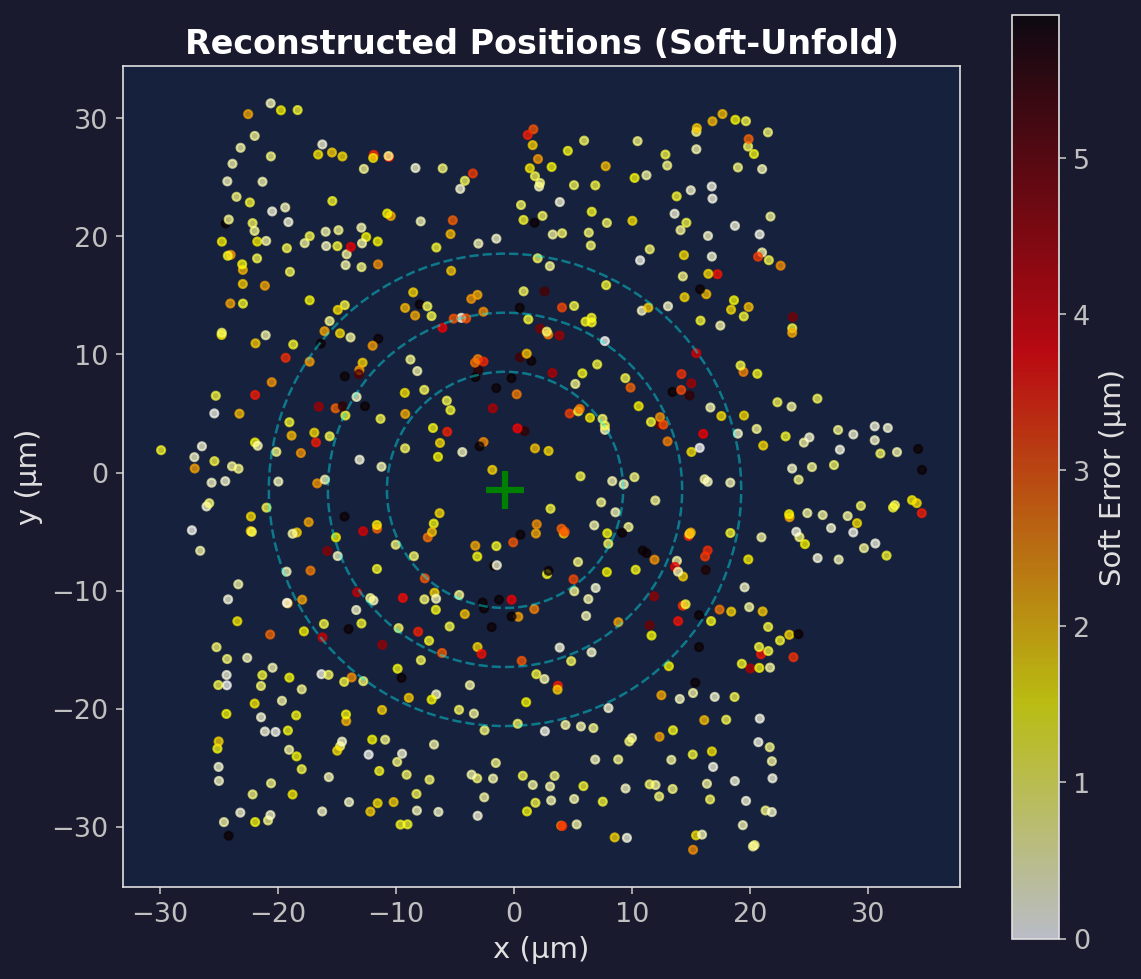
Hexagonal pixel spatial error scatter

Spatial error distribution across the hexagonal pixel cell

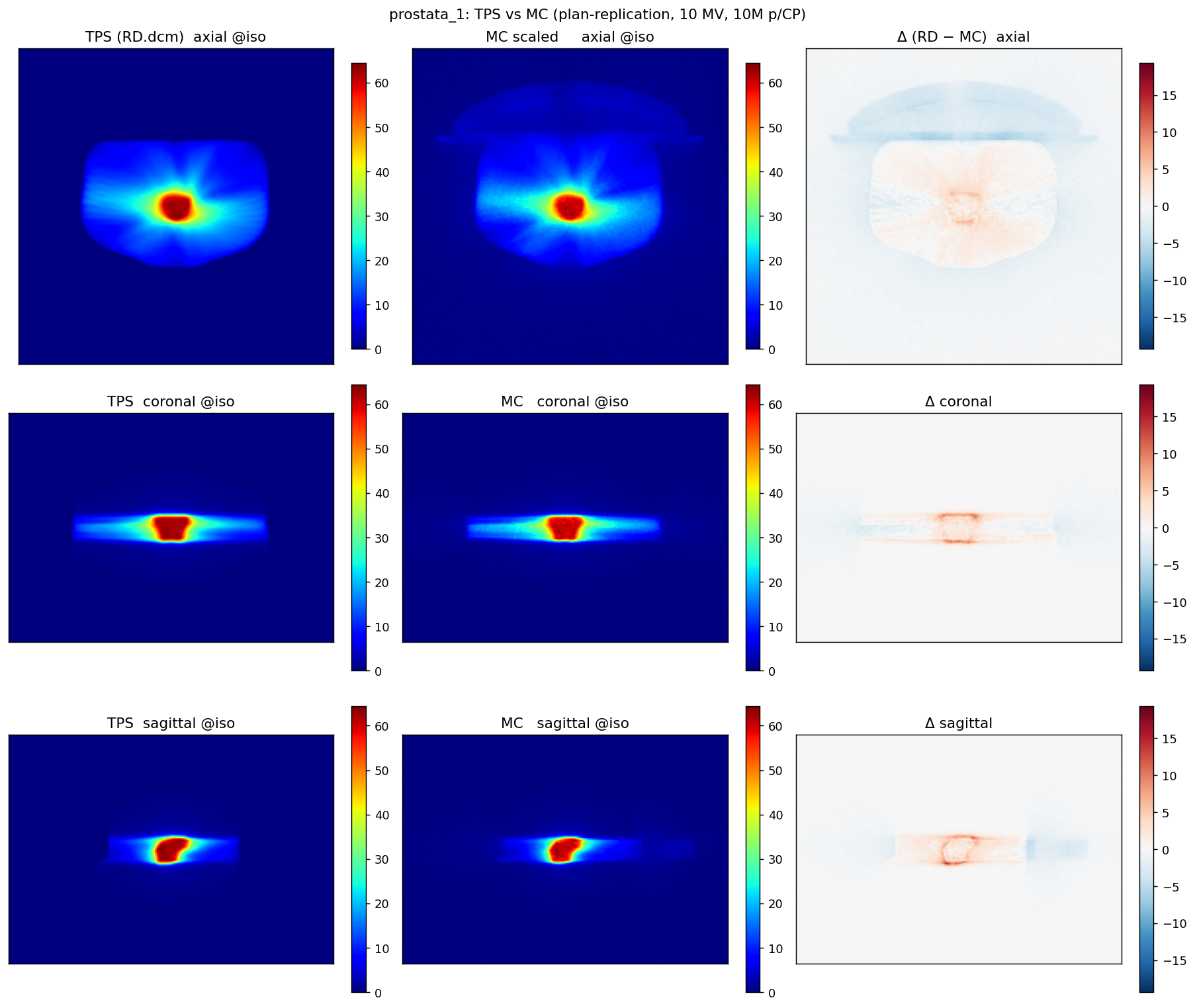
MC vs TPS dose comparison

Geant4 / OpenGATE MC versus clinical TPS. γ3 %/3 mm = 76.3 %

★ Flagship Active · IFCA HPC 2025 to present

EBRT Dose Prediction. Monte Carlo Dataset and Differentiable Neural Surrogate

Independent research project, with anonymised clinical data kindly shared by a medical physicist at Hospital Universitario de León. Currently submitted to the Santander X and UCEM innovation calls.

γ 3 %/3 mm = 76.3 % MC vs TPS γ ≈ 61 % held-out patient 37 M params · 3D TransUNet+FiLM 1611 MC projections · 9 patients

End-to-end pipeline for prostate VMAT radiotherapy. A Geant4 / OpenGATE 10 Monte Carlo simulator generates a physics-validated dataset of single-beam dose projections (9 patients, 179 gantry angles, around three weeks of HPC time on Altamira). A 3D TransUNet + FiLM neural surrogate, with a 4-channel physics-informed input (RED, WED, DTS, TERMA), learns to predict 3D dose in about one second, replacing minutes-to-hours of clinical computation.

Training uses DDP across 2 × NVIDIA A30, AMP-FP16, and a physics-informed composite loss (asymmetric dose-excess, gradient-match, mean-bias). The roadmap extends to a HeteroGNN amortized inverse-planner trained end-to-end through the differentiable surrogate, so that the optimiser converges to the mathematical optimum of the clinical objective without using clinician-approved plans as targets.

GitHub repository ↗ · PyTorch · Geant4 · OpenGATE · SLURM · DDP · A30
★ Flagship MSc Thesis · 2026 ESA ARRAKIHS · IFCA-CSIC

Deep U-Net for Faint Stellar Stream Detection amidst Galactic Cirrus

Master's Thesis at IFCA-CSIC, aligned with the science goals of the ESA ARRAKIHS mission.

Stream IoU > 0.84 Recall > 0.93 20 000 synthetic samples 4-band fusion (g/r + W1/W2)

Three-class semantic segmentation (background, stream, cirrus) of low-surface-brightness features in multi-band astronomical imagery. Stellar streams and galactic cirrus are morphologically similar but spectrally distinct: streams emit in the optical (SDSS g/r) while cirrus dominates in the infrared (WISE W1/W2). The 4-channel U-Net is built to exploit this physical asymmetry.

The training data is generated by a physics-informed synthetic pipeline (1/fβ fractal noise, Bézier-curve streams, real SDSS+WISE backgrounds via Aladin / HiPS), with 40 % of samples mined as adversarial edge cases. Bayesian HPO via Optuna and 4× Test-Time Augmentation at inference. The pipeline is intended as algorithmic infrastructure for the ARRAKIHS data analysis chain.

GitHub repository ↗ · TensorFlow · Optuna · AstroPy · FITS · HiPS
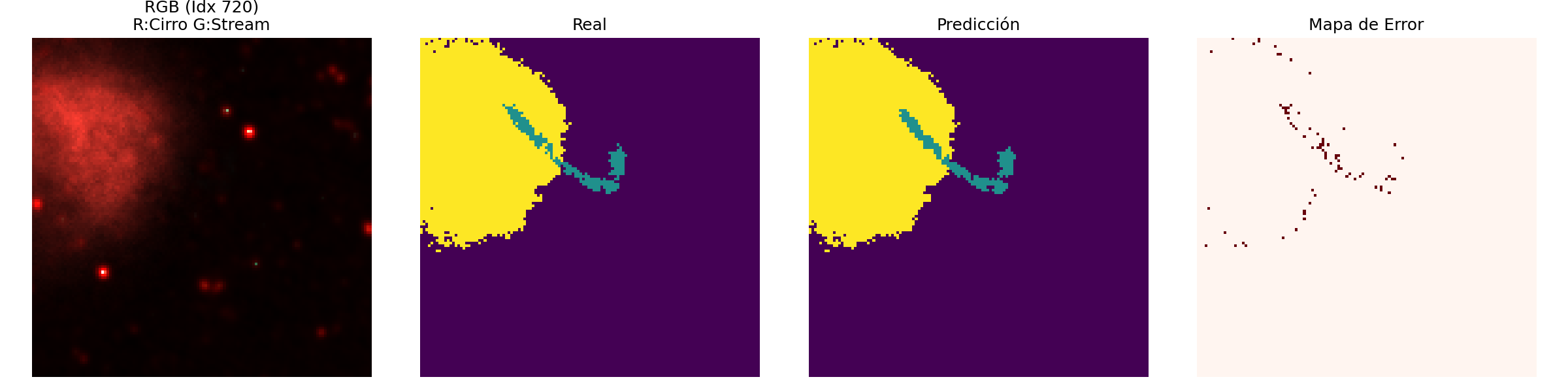
ARRAKIHS stream segmentation, wide panel of multiple test cases

Predicted vs ground-truth segmentation across a panel of randomly sampled test fields

Other Projects

github.com/igarciagomez ↗
Feb 2026 · Predecessor work

Sub-Micron Position Reconstruction in Square 3D-Trench Silicon Pixels

Multi-Domain CNN exploiting C₂v point-group symmetry

1.82 µm Euclidean MAE. Challenging SOTA (1.5 µm) 91.1 % quadrant accuracy

Square-pixel predecessor to the hexagonal flagship. Multi-domain CNN fusing time, frequency (hierarchical PCA) and C₂v irreducible representation features. 11-hour Bayesian HPO and multi-seed validation.

2025 · BSc Thesis

Gravitational Wave Emission from R-mode Instabilities in Neutron Stars

Bachelor's Thesis, University of Cantabria

Numerical simulation of the Chandrasekhar–Friedman–Schutz r-mode instability in rapidly rotating neutron stars. Coupled-ODE integration of the viscosity-limited mode amplitude and spin-down evolution, mapping the instability window in the (T, Ω) parameter space.

GitHub ↗ SciPy · GR

Education

MSc in Particle Physics

Oct 2025 to Jul 2026 (expected)

University of Cantabria.

Master's Thesis (TFM) at IFCA-CSIC, on the ESA ARRAKIHS science case. Additional 6 ECTS Research Project at IFCA-CSIC on hexagonal 3D-trench silicon pixels, with a first-author paper currently in preparation.

BSc in Physics

2021 to Feb 2026

University of Cantabria. English-track Mention (English-taught core curriculum).

Final-year thesis (TFG): numerical study of gravitational-wave emission from r-mode instabilities in neutron stars.

Research Interests & Open Problems

PhD focus areas

Medical Physics AI

Differentiable Monte Carlo, neural dose surrogates, amortized inverse planning. Beyond the imitation paradigm: GNN warm-starts coupled to L-BFGS refinement that find the true mathematical optimum of the clinical objective, not the clinician's compromise.

Particle Detector AI

Group-equivariant deep learning for sub-micron position reconstruction. Scaling C₂v and D₆ₕ symmetry-aware methods to tilted pixels, stereo-readout sensors and time-of-arrival discrimination, relevant for the ATLAS and CMS Phase-II tracker upgrades.

ML for Science

Physics-informed losses, synthetic data generation, the role of group theory as a structured inductive bias. Long-term: differentiable simulators (in the spirit of diff-rendering) that close the sim-to-real gap and enable end-to-end gradient flow from raw measurements to physical parameters.

Open problems I am actively thinking about

Theses & Publications

  1. Sub-Micron Position Reconstruction in Hexagonal 3D-Trench Silicon Pixels via a D₆ₕ-Symmetric Multi-Domain CNN

    In Preparation

    I. García-Gómez et al., 2026. Target venue: JINST or Nucl. Instrum. Methods A.

    First-author manuscript from the IFCA-CSIC Research Project on the W4 hexagonal sensor.

  2. Deep U-Net for Faint Stellar-Stream Detection amidst Galactic Cirrus

    MSc Thesis · 2026

    I. García-Gómez. Master's Thesis, University of Cantabria, IFCA-CSIC.

    Stream IoU > 0.84, Recall > 0.93, 4-band physics-informed synthetic dataset, ARRAKIHS-aligned.

    GitHub ↗
  3. Gravitational-Wave Emission from R-mode Instabilities in Neutron Stars

    BSc Thesis · 2025

    I. García-Gómez. Bachelor's Thesis, University of Cantabria.

    Numerical Chandrasekhar–Friedman–Schutz analysis. Viscosity-limited amplitude evolution and instability window in (T, Ω).

    GitHub ↗

Technical Toolbox

Deep Learning

PyTorch, TensorFlow / Keras, DDP, AMP, Optuna, torch_geometric (GNNs).

Scientific Computing

Geant4, OpenGATE, ROOT, NumPy, SciPy, SimpleITK, pydicom, AstroPy, FITS / HiPS.

Engineering

Python, R, Bash, LaTeX, Git, SLURM / HPC clusters, Jupyter, Linux servers.

Domains

Monte Carlo dose simulation, group-theory feature engineering, image segmentation, inverse problems.

Languages

Spanish (native). English (C2 effective, C1 certified, English-track BSc Mention).

Continuing Education

Two AI micro-credentials. Ongoing engagement with the ML-for-physics literature.